Auto Flush Option
An auto-flush toilet or bidet seat uses motion or seat-occupancy sensors to detect when the user has finished and automatically initiates the flush. By removing manual contact with the lever or button, auto-flush technology cuts down on germ transfer, eliminates accidental misses, and maintains a tidy bowl for the next visitor. Most systems include a manual override button for convenience and battery-backup or plug-in power options.
Infrared, time-of-flight, or pressure sensors detect departure and activate flush within 2–3 s.
Dual-flush or volume-adjustable models choose light or full flush automatically on select smart toilets.
Ideal for children, elderly, or guests who may forget or struggle with flush handles.
Manual override button or wave sensor lets users flush on demand when desired.
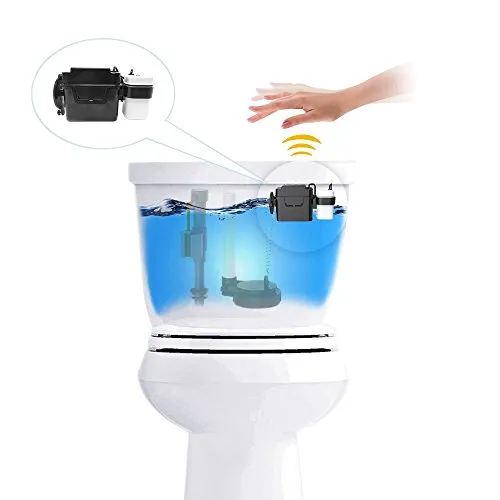
Key Benefits
Touch-Free Hygiene
Eliminates one of the most frequently touched—and germ-laden—fixtures in the bathroom.
- Reduces cross-contamination in shared restrooms.
- Pairs well with bidet seats for a fully hands-free experience.
Always-Clean Bowl & Odor Control
Automatic flushes prevent lingering waste, stains, and odors that can build up when users forget.
- Maintains guest-ready appearance between cleanings.
- Helpful in hospitality or office settings where janitorial visits are periodic.
Accessibility & Convenience
Ideal for users with limited mobility, arthritis, or dexterity challenges who may struggle with levers.
- No awkward reaching behind the seat or tank.
- Children enjoy a simpler, error-proof solution.
How It Works
1
Occupancy Detection
A seat pressure sensor or front-facing infrared module registers when someone is seated.
2
User Departure Signal
When weight is removed or motion sensor sees the user step back, a timer (≈1–3 s) starts.
3
Valve or Motor Activation
The control board energizes a solenoid or motorized flush valve, releasing water for the preset volume.
4
Manual Override & Wave Flush
A side button or hand-wave sensor provides immediate flush on demand or a second flush if needed.
5
Self-Check & Power Management
Battery-powered units perform low-power sleep and LED alerts, while AC models include backup battery fail-safe.
Who Needs This Feature
Commercial & Public Restrooms
Ensures every user leaves a clean bowl, reducing janitorial load and complaints.
Families with Young Children
No more reminders—kids can’t forget to flush what they never touch.
Seniors & Mobility-Impaired Users
Hands-free operation removes the need to twist or reach, enhancing safety and independence.
Germ-Aware Homeowners
Completes a touchless bathroom workflow alongside sensor faucets and soap dispensers.
Common Misconceptions
"Auto-flush toilets waste water by flushing too often."
Modern sensors include delay timers and false-trigger filters; water use matches manual habits or can even drop due to consistent single flushes.
"They require complex wiring and expensive maintenance."
Many retrofit kits run on replaceable AA batteries lasting 1–2 years; servicing involves simple cartridge swaps similar to standard valves.
"Sensors will flush while someone is still seated."
Quality systems use dual-sensor logic (seat + motion) or weight thresholds to prevent premature activation.
Frequently Asked Questions
Q: Can I retrofit auto-flush to my existing toilet?
A: Yes—after-market sensor valves replace the handle or fit over the flush lever; installation usually takes <30 minutes.
Q: How long do the batteries last?
A: Typical alkaline packs last 1–2 years at 10–15 flushes/day; LED indicators warn months in advance of low power.
Q: Is there a manual flush option during power loss?
A: All reputable systems include a mechanical override button or allow lifting the tank lid to actuate the valve manually.
Q: Will the sensor work with a closed lid?
A: Units using seat-pressure sensors function regardless of lid position; motion-only models need an open lid for line-of-sight.