High-Efficiency Toilet
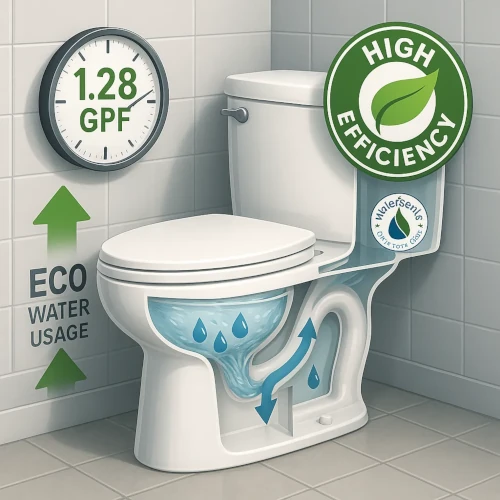
High-Efficiency Toilets (HETs) are engineered to use 1.28 gallons per flush—or less—compared with the 3.5 gpf fixtures common before 1994. They achieve this through larger 3–4 inch flush valves, refined bowl geometry, fully glazed trapways, and features such as siphon-jets or pressure-assist tanks. HETs carrying the EPA’s WaterSense® label must also prove ≥350 g MaP flush performance in independent testing, ensuring you save water **and** avoid double-flushing.
Flushes at ≤ 1.28 gpf (4.8 L)—up to 60 % savings vs. 3.5 gpf toilets.
Certified WaterSense® HETs must clear ≥ 350 g of waste in one flush.
Available in gravity, siphon-jet, dual-flush, or pressure-assist designs.
Often eligible for utility rebates or LEED water-efficiency points.
Key Benefits
Substantial Water & Cost Savings
Each flush uses roughly one third of the water of legacy toilets—translating to thousands of gallons saved yearly.
- Family of four can save 13 000+ gallons annually.
- Lower sewer and septic load extends system life.
Reliable, One-Flush Performance
Oversized flush valves and optimized bowls clear waste quickly, so you rarely reach for the handle twice.
- Many models score 800–1 000 g on MaP testing.
- Fully glazed 2 inch+ trapways reduce clog risk.
Eco-Friendly & Code-Ready
Meets or exceeds 2025 plumbing codes and helps earn points toward LEED, Green Globes, and other certifications.
- WaterSense label meets stringent performance and efficiency benchmarks.
- Qualifies for rebates from hundreds of North-American utilities.
How It Works
1
Large Flush Valve Opens
3–4 inch valve releases water rapidly, creating strong bowl wash-down.
2
Optimized Rim & Jet Flow
Precisely angled rim holes or a siphon-jet target sweep waste and prime the trapway.
3
Efficient Siphon Action
Trapway geometry and full glazing maintain momentum, evacuating contents with minimal water.
4
Quick Refill & Seal
Float or pressure vessel resets; tank refills in 40–60 seconds, ready for the next flush.
5
Independent Performance Verification
MaP and WaterSense tests certify both waste removal and low-volume consumption.
Who Needs This Feature
Eco-Conscious Homeowners
Significant, measurable water conservation without lifestyle trade-offs.
Regions Facing Drought or High Water Rates
Every gallon saved eases strain on municipal supplies and wallets.
New Construction & Remodels Seeking Certification
Necessary for WaterSense, LEED, and many progressive building codes.
Septic-System Properties
Lower flush volumes reduce tank loading and extend pump-out intervals.
Common Misconceptions
"High-efficiency toilets always require double-flushing."
Certified HETs must pass ≥ 350 g MaP testing—equal to or better than old 3.5 gpf models.
"They cost much more than standard toilets."
Price gaps have largely disappeared, and rebates can offset the difference entirely.
"Water savings are negligible compared with faucet or shower upgrades."
Toilets account for ~30 % of indoor water use; HETs deliver some of the fastest, easiest savings.
Frequently Asked Questions
Q: How much water will I really save?
A: Replacing a 3.5 gpf toilet with a 1.28 gpf HET saves ~2.2 g per flush—over 13 000 g per year for a four-person household.
Q: Are HETs available in both round and elongated bowls?
A: Yes—manufacturers offer HETs in round-front, elongated, compact-elongated, and even wall-hung formats.
Q: Do I need higher water pressure for an HET?
A: No. Gravity HETs work at the same 20–80 psi supply range as standard toilets.
Q: Can I get a rebate for installing one?
A: Many U.S. and Canadian utilities offer $25–$100 rebates for WaterSense-labeled HETs—check your local program.