Pressure-Assist
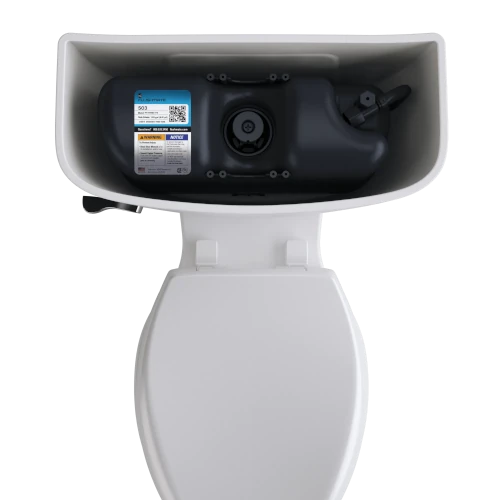
Unlike standard gravity toilets, a pressure-assist model stores supply water inside a plastic or stainless steel pressure tank nested inside the porcelain tank. As the tank fills, incoming water compresses the trapped air, charging the system to roughly 25–30 psi above ambient. When the flush valve opens, the pressurized water is expelled into the bowl in a split-second surge that scours the rim, activates a rapid siphon, and sends waste down the drain with minimal residual streaking. This engineering delivers commercial-grade power at home while meeting modern 1.0–1.28 gpf efficiency targets.
Sealed pressure vessel (“tank-within-a-tank”) charges to ~25–30 psi.
Typical flush volume: 1.0–1.28 gpf (high-efficiency) or legacy 1.6 gpf units.
Clears 1 000 g MaP loads consistently—virtually eliminates double-flushing.
Louder than gravity flush but faster (<1 s bowl evacuation).
Key Benefits
Maximum Flush Power
Pressurized water enters the bowl at high velocity, sweeping waste instantly and reducing clogs even in older 3-inch drain lines.
- Ideal for homes plagued by frequent plunger use.
- Maintains high MaP ratings even as water volume drops.
Water Savings & Green Certifications
Many pressure-assist bowls hit WaterSense 1.28 gpf—and some reach 1.0 gpf—cutting consumption 20–60 % vs. 3.5 gpf relics.
- Eligible for municipal rebates where offered.
- Reduced tank sweat because water never contacts porcelain wall.
Low Maintenance in High-Traffic Settings
Commercial restrooms and busy households benefit from fewer clogs and less bowl-brush time.
- No flapper to warp; cartridge kits drop in for quick service.
- Less residual odor thanks to complete bowl evacuation.
How It Works
1
Filling & Pressurizing
Incoming line water fills the inner vessel, compressing trapped air to ~25–30 psi above supply pressure.
2
Flush Valve Trigger
A push-button or trip lever opens a discharge valve; compressed air forces water out in <1 s.
3
High-Velocity Bowl Wash
Water jets through rim wash holes and a large jet at the bowl outlet, rapidly priming the siphon.
4
Complete Bowl Evacuation
Siphon pulls waste down the trapway; strong momentum minimizes skid marks.
5
Refill & Re-pressurize
Valve closes, vessel refills, and air pocket recompresses—ready for the next flush within ~45 s.
Who Needs This Feature
Commercial & Public Restrooms
Restaurants, offices, schools, and gyms that demand clog-free reliability and faster turnover.
Large or Multi-Generational Households
High daily flush counts magnify the value of fewer clogs and water savings.
Homes with Weak Drain Line Pitch
Extra force pushes waste farther on long or undersized runs in older plumbing.
Eco-Conscious Remodels Seeking Power
Balances aggressive 1.0–1.28 gpf targets with commercial-grade performance.
Common Misconceptions
"Pressure-assist toilets use more water than high-efficiency gravity models."
Many versions flush at 1.28 gpf or less—on par with WaterSense gravity options—while offering greater clearing power.
"They require special plumbing or higher supply pressure."
Any standard 20–80 psi household line works; the vessel self-pressurizes without external pumps.
"Pressure-assist systems are prone to exploding."
Modern units include ASSE/ANSI 1002 safety certification, pressure-relief valves, and durable injection-molded tanks rated far above line pressure.
Frequently Asked Questions
Q: How loud is a pressure-assist flush?
A: Roughly 70–75 dB—about like a shower turning on. The sound lasts <1 second and can be muted further with insulated tank lids.
Q: Can I retrofit a pressure vessel into my current toilet?
A: No—the bowl geometry and tank dimensions are engineered together. Replace the entire fixture for best performance and warranty coverage.
Q: Do pressure-assist toilets sweat less in humid climates?
A: Yes. Water is isolated inside the vessel, so the porcelain tank wall stays room-temperature, preventing condensation.
Q: What maintenance is required?
A: Every 5–7 years replace the cartridge O-rings or flush valve seal—no flapper chains or float arms to adjust.